The Crime of Separate Action
Naked LunchThe Crime of Separate Action is both a private fear and a political principle: the possibility that a person might act independently, outside the control that claims to contain them. The phrase first takes shape in the writer’s recurring check of his reflection, then expands into a vision of public authority that hunts for “the crime of separate life.” Its force lies in that movement from the mirror to the state: a disturbance in self-recognition becomes the model for a world determined to suppress separate existence.
The Mirror and the Fear of Disobedience
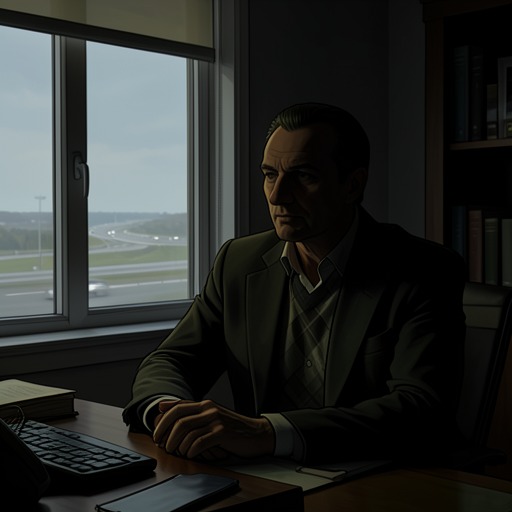
The writer describes seeing himself read to the mirror “as always.” The ritual is not presented as casual vanity; he checks the reflection to reassure himself that the crime has not occurred and cannot occur. The mirror thus becomes a test of control. What it should confirm is a correspondence between the observer and his image, but the need to check already exposes uncertainty about whether that correspondence can be trusted.
The passage defines the feared crime as the moment “the reflection no longer obeys.” The disobedient image would make visible a loss of control that is at once intimate and alarming. The writer remarks that anyone who has looked into a mirror knows what the crime means, making the possibility seem rooted in an ordinary experience of self-recognition even as its consequences exceed ordinary life. By the time help might be sought, the passage suggests, it is “Too late to dial P o l i c e.” The police appear not as a reliable remedy but as a belated recourse against a rupture already underway.
Divided Agency and Continuous Surveillance
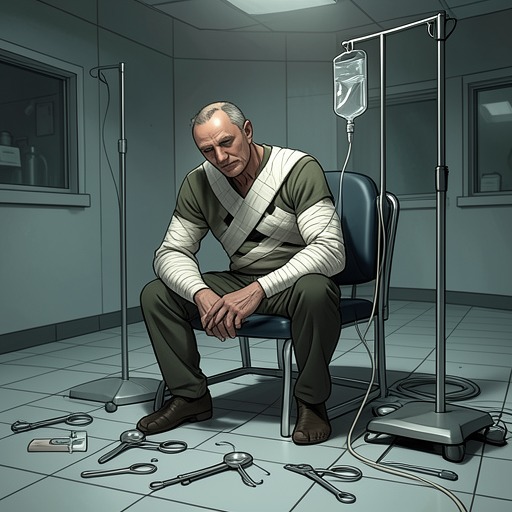
The expression is closely related to the account of possession elsewhere in the passage. The speaker rejects the idea that he is normally present in a stable, fully possessed self: “I am never here.” He describes himself as both Outside, issuing orders, and Inside a yielding body that reforms ahead of movement and thought. The image makes agency a contested position rather than a secure possession. Even the effort to direct action takes place within a body and system that constrain it.
Against this divided condition, patrolling becomes the speaker’s “principle occupation.” Security may be tight, but the speaker claims to remain somewhere beyond it while also being enclosed within the body. This paradox sharpens the meaning of separate action: the feared independence is not simply freedom from supervision, but a break in the continuous system of command, monitoring, and response. The mirror’s possible disobedience is one compact image of that larger instability.
From Private Rupture to Political Crime
The phrase broadens into an explicitly political landscape. A “black wind sock of death” moves over the land, searching for the crime of separate life, while population blocks disappear in a “checker game of genocide.” The imagery converts individuals and communities into units exposed to a system of elimination. Separate life is not merely condemned in speech; the passage imagines it being sought out and removed at population scale.
Political authority gives that threat a public voice through senators demanding the death penalty for drug users, people marked as sexual offenders, and those judged to offend prevailing norms. The passage presents these demands as animated by an “inflexible authority of virus yen,” connecting punitive law to an appetite for control that reproduces itself. The language does not offer a neutral account of legislation; it places the demand for punishment within the same expanding logic that marks difference as a danger.
The press also joins the campaign. Liberal, less liberal, and reactionary newspapers are grouped together in approval of the claim that the myth of “other-level experience” must be eradicated. The political response treats alternative experience as something to suppress, while the press gives that suppression a shared public justification. The progression—from a reflection that might cease to obey, to independent lives targeted by institutions—makes the expression a name for a single principle operating at different scales.
Refusal, Limits, and Significance
The text distinguishes representation from enactment. It permits writing, shouting, singing, painting, performance, and other forms of expression, but draws a sharp boundary at action: “So long as you don't go and do it, .” The unfinished punctuation leaves the warning hanging rather than resolving it into a fully stated rule. Expression may be tolerated so long as it does not become conduct that escapes the limits imposed on it.
The political horizon remains bleak. Power groups are described as frantically cutting lines of connection, and the planet drifts toward “random insect doom.” The expression therefore does not point to one isolated offense or a single law. It gathers the mirror’s feared disobedience, the speaker’s unstable relation to bodily agency, punitive demands, censorship of alternative experience, and the severing of connections into a critique of control that cannot accept autonomous life. The intimate check before the mirror and the imagined hunt across the land are two scales of the same fear: that something might move, think, or exist beyond the system’s command.